
Apple's iPhone 18 Pro is the company's first phone built on a 2-nanometer chip, the first with a mechanically variable camera aperture, and the first to start at $1,199. Those three facts are related, and understanding how is the point of this piece.
The headline features are genuinely new for an iPhone. But the phone around them is not: same dimensions, same screen sizes, same buttons and ports as last year. That makes this an unusually clear test case. Strip away the design changes that normally muddy a year-over-year comparison, and what's left is a question about silicon, optics, and a memory market that pushed prices up before Apple ever took the stage.
What Apple Announced — and What It Didn't
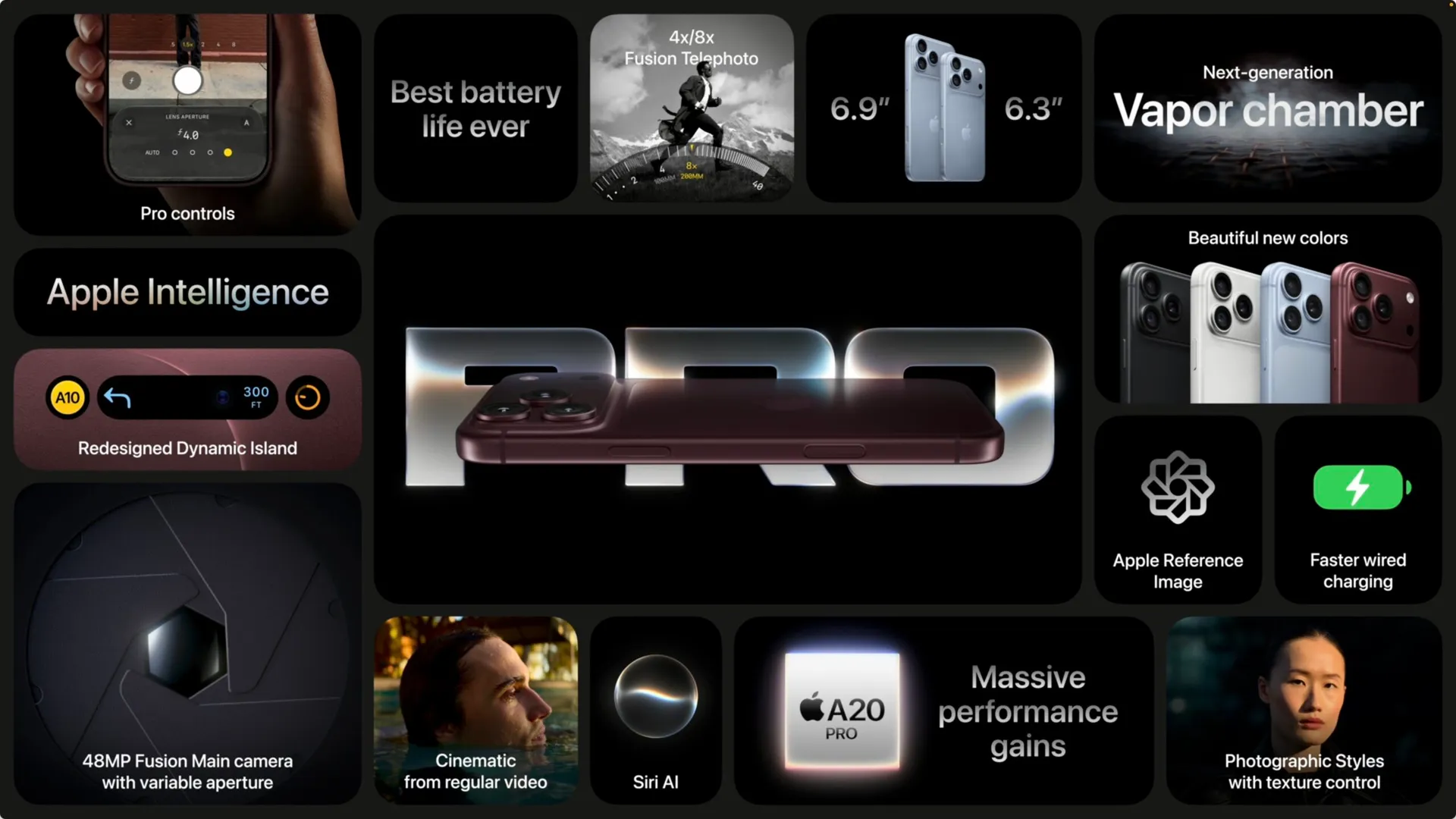
Apple announced the iPhone 18 Pro and iPhone 18 Pro Max at its "Surprise and shine" event at Apple Park, with prices starting at $1,199 and $1,299. Both phones get the A20 Pro, Apple's first 2-nanometer chip, a 48MP main camera with a variable aperture, a smaller Dynamic Island and up to 45 hours of video playback on the Pro Max. The event took place on September 9, 2026, and it was John Ternus's first keynote as CEO, eight days after he succeeded Tim Cook, who is now executive chairman.
Ternus framed the launch around four areas.
"We made massive advancements in the most important areas: intelligence, performance, battery, and camera," Ternus said.
What Apple didn't announce is nearly as significant. Apple did not introduce the plain iPhone 18, likely reserving scarce resources for the higher-margin iPhone 18 Pro models and the new iPhone Duo foldable phone. Rumors have long suggested Apple would split the lineup this way, with the iPhone 18 reportedly due in early 2027, a schedule that may help Apple manage constrained component supplies more efficiently. If you're waiting for a sub-$1,000 iPhone 18, the current reporting points to spring 2027 — not this fall.
Beyond the three headline changes, the hardware is deliberately familiar. The iPhone 18 Pro is remarkably similar to its predecessor, with identical case dimensions, unchanged buttons and ports, 6.3-inch and 6.9-inch screen sizes, Face ID, satellite connectivity, sensors, and MagSafe charging. Apple offers the phones in black, silver, glacier, and burgundy.
iPhone 18 Pro Pricing: Where the $100 Actually Goes
The short answer to "why is the iPhone 18 Pro more expensive?" is memory. The pricing arrives after months of speculation that Apple would raise iPhone prices more steeply this year, following a broader run of cost increases across its Mac, iPad, and home product lines earlier in 2026 tied to the global memory shortage.
The increase amounts to $100 over the equivalent iPhone 17 Pro and Pro Max pricing, matching what Bloomberg's Mark Gurman had predicted ahead of the event. That is a smaller jump than many analysts had floated over the summer. Compared with the pre-event fear, $100 reads almost like relief. But the base price is only part of the picture.
The storage tiers tell a bigger story
The $100 figure applies to the 256GB and 512GB configurations. Above that, the gap widens sharply. There's a $100 year-over-year increase if you go up to 512GB ($1,399), but if you want 1TB of storage, you're going to be paying $300 more. A 1TB iPhone 18 Pro is priced at $1,799, but a 1TB iPhone 17 Pro was $1,499. There's a new 2TB option for the Pro this year, and it's priced at $2,399.
The Pro Max follows the same pattern. A 1TB iPhone 17 Pro Max was $1,599, but this year, it'll cost you $1,899 to get a 1TB iPhone 18 Pro Max. The 2TB iPhone 18 Pro Max option is even more expensive at $2,499, a $500 increase over the 2TB iPhone 17 Pro Max price.
Configuration | iPhone 17 Pro (2025) | iPhone 18 Pro (2026) | Change |
Pro, 256GB | $1,099 | $1,199 | +$100 |
Pro, 512GB | $1,299 | $1,399 | +$100 |
Pro, 1TB | $1,499 | $1,799 | +$300 |
Pro, 2TB | Not offered | $2,399 | New tier |
Pro Max, 256GB | $1,199 | $1,299 | +$100 |
Pro Max, 1TB | $1,599 | $1,899 | +$300 |
Pro Max, 2TB | $1,999 | $2,499 | +$500 |
US pricing as reported by MacRumors on September 9, 2026.
This is the part of the story that makes the memory-shortage explanation credible rather than convenient. If Apple were simply raising margins, you'd expect a flat increase. Instead, the surcharge scales with NAND capacity — exactly what you'd expect when the input cost of flash storage is what's rising. Storage and memory costs have been soaring because of ongoing supply shortages, so it's not too surprising to see a notable surcharge on the 1TB storage option.
For buyers, the practical takeaway is that the 256GB and 512GB models absorb the smallest hit. The 1TB and 2TB tiers are where the memory crisis is really being priced in.
Inside the A20 Pro: Apple's First 2nm iPhone Chip
What Apple says the chip delivers
2 Built using the latest 2-nanometer process technology, A20 Pro sets a new bar for mobile computing, according to Apple. iPhone 18 Pro runs on Apple's new A20 Pro chip, built on a 2 nanometer process, with a 6-core CPU (2 super cores, 4 efficiency cores). Apple has retired the "performance core" label in favor of "super cores," and 5 the new SoC boasts a 6-core CPU with two of the company's super-cores (20% faster than last generation), and there are also four efficiency cores with neural accelerators.
On the graphics side, 9the A20 Pro pairs a 6-core CPU with a 7-core GPU that Apple says is up to 40 percent faster than the A19 Pro. A dual 16-core Neural Engine doubles the AI processing of last year's chip, and a next-generation vapor chamber attached directly to the chip has three times the surface area of the prior design, helping deliver up to 40 percent better sustained performance than the iPhone 17 Pro.
Memory is the quieter but arguably more important upgrade. 8Both the iPhone 18 Pro and iPhone 18 Pro Max ship with 12GB of unified memory — consistent with the iPhone 17 Pro's allocation — and 50 percent higher memory bandwidth than the A19 Pro. The significance of 12GB in the context of on-device AI is architectural: Apple's Apple Intelligence suite runs large language model inference locally, and LLM throughput is fundamentally limited by memory bandwidth, not just compute speed.
A note on these numbers: every figure above is Apple's own claim. At the time of writing, we have not independently verified benchmark results for the A20 Pro, and none are included here.
The A20 Pro also isn't Apple's first 2nm chip overall. 5The A20 Pro is Apple's first 2-nanometer chip in an iPhone. Its first-ever 2 nm chip is the M6, which the company announced in August and which will debut in the Mac mini later this month. 6Apple silicon generations share much of their architecture across the A-series and the M-series, so a new A-series chip normally functions as a partial preview of the M-series chip that follows it. This year the order reversed; the M6 was revealed on August 25, ahead of the A20 Pro.
What "2nm" actually means at TSMC
The "2nm" in A20 Pro refers to TSMC's N2 process node. It is worth being precise about what that label does and does not mean, because the marketing number has been decoupled from any physical measurement for years. "2nm" is a generation name, not a gate length.
41 TSMC's 2nm (N2) technology started volume production in 4Q25 as planned. N2 technology features industry-leading first-generation nanosheet transistor technology, with full-node strides in performance. The foundry's own published figures for the node, disclosed at the IEEE International Electron Devices Meeting in December 2024, are as follows: 37 TSMC's new 2nm technology delivers up to 15% faster performance or up to 35% greater energy efficiency compared to its 3nm process, while also enhancing transistor density by 15%. Earlier TSMC guidance framed the efficiency gain slightly more conservatively, at 40 10% to 15% higher performance at the same power and complexity as well as a 25% to 30% lower power consumption at the same frequency and transistor count when compared to TSMC's N3E.
Two things matter about these numbers. First, they are "or" figures, not "and" figures. A chip designer chooses where to spend the gain — on clock speed, on power, or on cramming in more transistors — and cannot claim all three simultaneously. 38They are not confirmed A20 Pro performance gains, and they should not be added together as if every device will become 15 percent faster while simultaneously using 30 percent less power. Processor designers decide how to use the available gains. Some parts of the chip can target higher frequency, while others prioritize lower consumption or additional transistors.
Second, the density gain is modest. A roughly 1.15× density improvement is a smaller jump than the industry historically associated with a "full node." The real story of N2 is not that transistors got dramatically smaller — it's that they got a fundamentally different shape.
FinFET vs. gate-all-around nanosheets
For more than a decade, leading-edge chips have used FinFET transistors, in which the current-carrying channel stands up like a vertical fin and the gate wraps around three of its sides. N2 abandons that structure. 39TSMC's N2 is the company's first process node to adopt gate-all-around (GAA) nanosheet transistors, where the gate fully surrounds the channel formed by stacked horizontal nanosheets. This geometry improves electrostatic control, reduces leakage, and enables smaller transistors without sacrificing performance or power efficiency, ultimately increasing transistor density.
Why does wrapping the gate around all four sides matter? Leakage. When a transistor is supposed to be off, a small amount of current still trickles through the channel. As transistors shrink, that leakage becomes a larger share of total power draw. Better gate control means a transistor that switches off more completely, and that translates directly to battery life in a device that spends most of its day doing very little. 38Better control can reduce leakage when a transistor is inactive while allowing greater performance when it is working. That combination is valuable inside an iPhone, where a processor constantly shifts between brief high-performance bursts and long periods of light background activity.
Nanosheets also give designers a knob FinFETs never had. 37The key difference lies in the improved control over current flow and the flexibility to design a wider range of devices by adjusting the width of the nanosheets. In contrast, FinFETs could only vary device characteristics by increasing the number of fins. Nanosheets, however, allow for more nuanced variations, enabling designs equivalent to fractional fins, like 1.5 fins, providing better optimization for specific logic circuits. In practice, that lets Apple tune the transistors in the efficiency cores differently from those in the super cores, on the same die, with finer granularity than before.
TSMC is not the first to ship GAA transistors — 37Samsung started initial production of its 3nm node applying GAA transistor architecture as early as in 2022. But the A20 Pro is the first time this transistor architecture has shipped inside a product with iPhone-scale volume, which is a different kind of milestone.
What the teardown confirmed
Until this month, everything above was foundry data. That changed on September 22. 42TechInsights has now extracted the A20 Pro from an iPhone 18 Pro, independently measured production silicon, and published preliminary findings that transform those claims from foundry-asserted to independently validated. 42TechInsights confirmed that the A20 Pro deploys gate-all-around nanosheet transistors — a fundamental structural departure from the FinFET technology that has defined leading-edge semiconductor manufacturing since Intel introduced it in the early 2010s.
The findings are described as preliminary, and the full report is behind TechInsights' subscription. But the core architectural claim — that a nanosheet chip is now in a mass-market phone — is no longer resting on TSMC's word alone.
There's also a supply-side angle. 8Apple reportedly secured early access to TSMC's N2 production capacity, giving the A20 Pro a meaningful head start ahead of comparable Android silicon on this architecture. That lead won't last indefinitely. 3The Snapdragon 8 Elite Gen 6 Pro is expected to end up in the Galaxy S27 Ultra, and is already reported to be 35% faster. Those competing figures are unverified pre-release claims, but they signal that Apple's process-node advantage is a window, not a moat.
What N2 still doesn't have
One thing the A20 Pro does not include is backside power delivery — routing power through the back of the wafer so signal wiring on the front has more room. TSMC originally discussed this feature alongside N2, but it has since been moved to the next node. 41TSMC A16 technology integrates leading nanosheet transistors with innovative backside power rail solution, bringing greatly improved logic density and performance. So the A20 Pro is a first-generation nanosheet chip with conventional front-side power. There is a clear path to more from the same transistor architecture, and an enhanced N2P variant is on TSMC's roadmap for later in 2026.
The Variable Aperture Camera, Explained
How the mechanism works
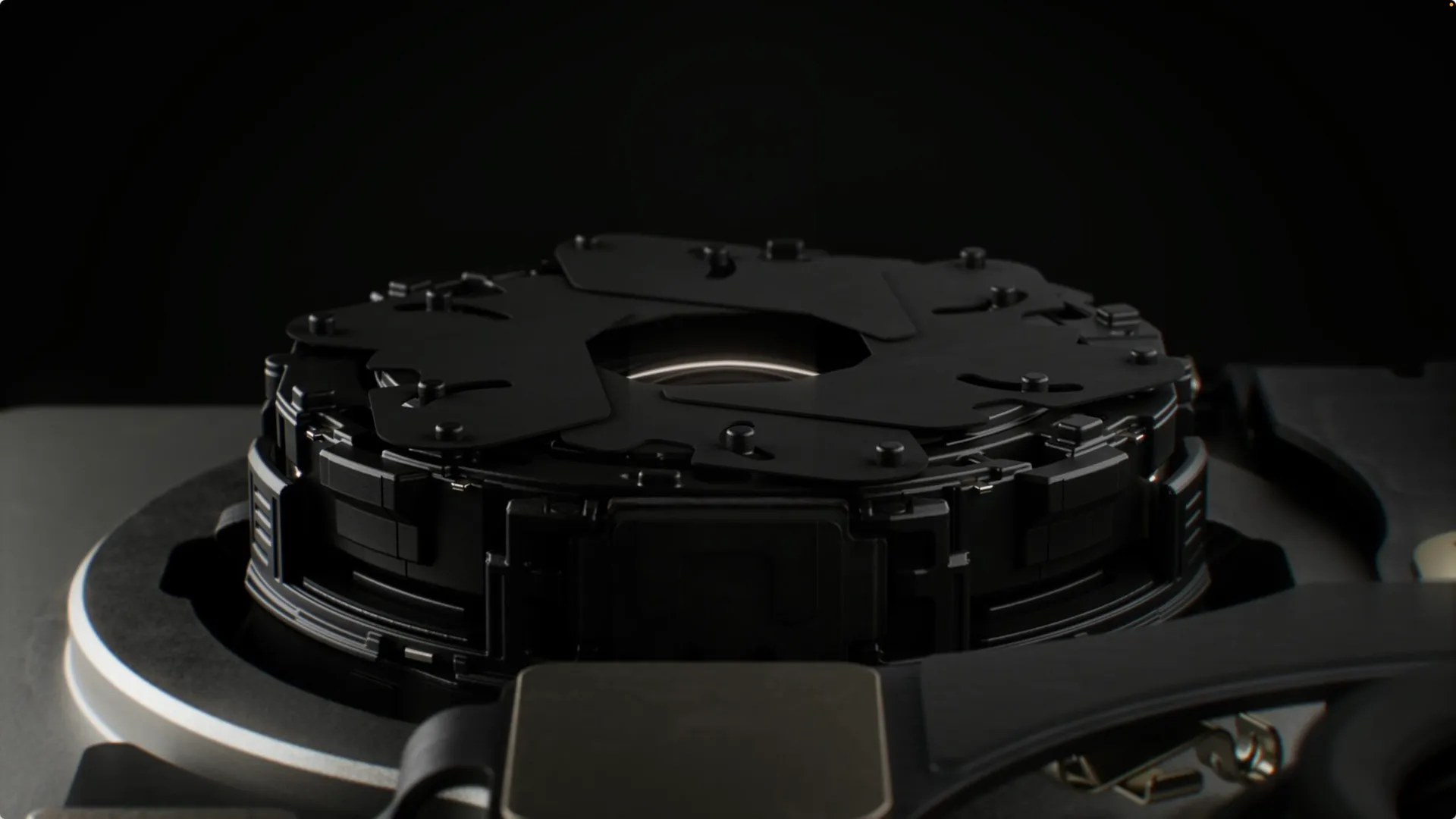
2 The new 48MP Fusion Main camera, now with variable aperture, brings creative control that wasn't possible before, and new Pro controls let users customize their experience in the Camera app. Mechanically, 9 the headline camera change is a 48MP Fusion main camera with a variable aperture that moves between f/1.48 and f/4 using six laser-cut blades. 31 The system was built using six laser-cut blades that are each thinner than a human hair. The rotor mechanism helps move the blades automatically, while the lens is custom-made for the feature.
This is the same principle as the iris in a dedicated camera lens, shrunk to fit behind a smartphone's sapphire cover glass. Every previous iPhone had a fixed aperture; the light-gathering capability and depth of field were baked into the lens. 28Last year's main lens was fixed at f/1.78. Apple opened the new one about half a stop wider to f/1.48, which is where the "50 percent more light" line in the keynote comes from, and added blades so it can also close down to f/4.
Apple's camera hardware lead has explained that the aperture mechanism wasn't the original goal. According to Matt Waldon, Senior Director of Camera & Depth Hardware at Apple, speaking to PetaPixel, 33"we really wanted to improve the sensitivity." Opening the lens wider was the way to gather more light — but a wider lens means shallower depth of field, which isn't always wanted. The variable aperture is what lets Apple have the wider lens without forcing that trade-off on every shot.
Four stops, and what each one is for
Although the mechanism can adjust continuously, users get discrete choices. 33Mobile photographers and videographers can switch between f/1.48, f/1.8, f/2.8, and f/4, though the default is f/1.8. Apple says f/1.8 remains the best overall choice because it is very sharp, still delivers some background blur when the subject is close to the camera, and is familiar to users. In automatic mode, behavior is different: 30when you aren't manually controlling it, the iPhone will steplessly adjust the aperture anywhere between wide-open and fully closed, depending on what it evaluates as necessary in a scene.
Aperture | Light gathered | Depth of field | Typical use |
f/1.48 | Most | Shallowest | Low light; isolating a single subject with optical background blur |
f/1.8 (default) | High | Shallow | General photography; Apple's recommended balance of sharpness and blur |
f/2.8 | Moderate | Moderate | Small groups; scenes where mild separation is wanted |
f/4.0 | Least | Deepest | Landscapes, architecture, staggered groups; slower shutter in bright light |
Why does depth of field matter in practice? 34If you shoot a staggered group at a fast aperture like f/1.48, someone standing in the front row might be sharp while family members two rows back appear softly blurred. Stopping down to f/4.0 deepens the focus plane so every face in the frame remains crisp and clear.
The trade-offs are the same ones every lens designer lives with. 33"So there is a little bit of trade off as you go to higher or lower apertures, where you sacrifice a little bit of sharpness [at f/1.48 because of aberrations] and on the long end, [f/4], because of diffraction," Waldon explains.
It's also important to be clear about scope. 35The variable aperture is only on the 48MP main lens, so the 48MP 4x telephoto and 48MP ultrawide cameras only have fixed apertures: f/2.8 and f/2.2, respectively. And 35it's not quite DSLR-level, where you can stop down to, say, f/11, which can be useful for deep focus and for capturing ultra-bright objects like the moon at night.
What early testing shows
Reviewer reactions have been mixed in an informative way. The optical blur at f/1.48 is drawing consistent praise. 29What makes the f/1.48 shot stand out over Portrait Mode is that it doesn't rely on software to guess edge boundaries, which often leads to messy cutouts. Instead, this wider physical aperture delivers the natural optical falloff you'd expect from a dedicated mirrorless camera.
But sharpness across the range appears to be flatter than the spec sheet might suggest. Fstoppers, after testing all four stops against an iPhone 17 Pro, found that 28if anything, f/4 is slightly sharper than f/1.48. The reviewer's pick for the best aperture on this lens would be f/2.8, but the honest answer is that all four settings land close enough together that nobody is going to spot the difference in a real photograph. The same review concluded that 28in ordinary light this camera takes essentially the same photograph as last year's did.
That's not a contradiction; it's the point. The variable aperture isn't about making every photo better. It's about letting the photographer choose which trade-off to make — something a fixed lens can never offer.
One thing that hasn't changed: 30the telephoto and wide-angle lenses are wholly unchanged. Whether the main sensor itself is new is less clear. PetaPixel reports that 30while the sensor has hardware changes, those are related to Apple Reference Image, not its ability to capture light. Apple Reference Image is a new provenance feature: 4it proves the authenticity of a photo by adding metadata that ensures an image is not AI-generated. It stores a reference image alongside image edits so the source material can always be verified.
Durability is an open question. 31The system appears incredibly delicate. While it is safe behind the sapphire glass of the iPhone lens, it will be interesting to see if it runs into problems later. No independent long-term data exists yet.
The Smaller Dynamic Island and the Rest of the Changes
The Dynamic Island shrink is the third visible change. 2Using advanced display technology, the Dynamic Island is redesigned to create room for additional information. The upgraded Dynamic Island can now show three Live Activities at once, while continuing to enable Face ID for securely unlocking iPhone 18 Pro models, authenticating purchases, signing in to apps, and more. Pre-launch rumors of under-display Face ID did not materialize; Face ID hardware still lives in the island.
Battery life is where the 2nm efficiency gains should show up most directly. 8Apple rates the Pro Max at 45 hours video playback, up from 39 hours on the iPhone 17 Pro Max; the Pro reaches up to 36 hours, up from 33 hours. Both gains reflect the combination of the A20 Pro's improved power efficiency, the lower-power C2 modem, and increased battery cell capacity — particularly in eSIM-only configurations, where the space previously occupied by a physical SIM tray contributes to battery volume. These are Apple's rated figures; independent battery testing is still emerging.
Storage now tops out at 2TB. 11Both models offer a 2TB storage option for the first time, sitting above the previous 1TB ceiling for an added cost.
Is the iPhone 18 Pro Worth the $100 Price Hike?
This is the question most readers actually have, and the honest answer depends on which phone you're coming from.
From an iPhone 17 Pro: Difficult to justify. The chassis, display, telephoto, ultrawide, and front camera are the same. The A19 Pro is not slow. The variable aperture is genuinely new, but in ordinary daylight, independent testing suggests the photographs look very similar to last year's. The strongest case is battery life — if the rated gains hold in independent testing, six extra hours on the Pro Max is meaningful. But you would be paying $100 more than last year's launch price for a phone that is, by design, an evolution.
From an iPhone 15 Pro or older: A much easier case. You gain the A20 Pro's efficiency, the 12GB of memory that Apple's on-device AI needs, substantially longer battery life, the variable aperture, and 256GB as the new floor. The $100 increase is real, but it's spread across three or more generations of improvement.
For photographers specifically: The value hinges on whether you'll actually use manual aperture control. If you shoot groups, landscapes, or in mixed light and have been frustrated by Portrait Mode's software edges, this is the first iPhone that solves that problem optically. If you leave the camera on Auto, the benefit is real but subtle.
For the memory crunch itself: There is no way around it. If you need 1TB or more, this is the most expensive iPhone generation ever at those tiers, by a wide margin. If 256GB or 512GB is enough, the increase is contained.
One market signal is worth noting. 12Despite the hype around the Duo, the 18 Pro and 18 Pro Max are getting plenty of attention from consumers. Try ordering an iPhone 18 Pro or iPhone 18 Pro Max today, and you'll have to wait 3 weeks before it's in your mailbox. Early demand, at least, does not appear to have been dented by the price.
Availability and Timeline
9 Pre-orders opened Saturday, September 12 at 5 a.m. PT. The phones shipped Friday, September 18 in more than 65 countries and regions, with 20 more countries following on Friday, September 25. 27 On Friday, September 18, Apple debuted iPhone 18 Pro and iPhone 18 Pro Max, as well as Apple Watch Series 12, Apple Watch Ultra 4, and AirPods 5, at Apple Store locations worldwide.
Financing and trade-in options are available. 10Apple is offering the iPhone 18 Pro and iPhone 18 Pro Max through its Apple Upgrade program, which starts at $34.99 a month over 24 months and can come in lower for customers who trade in an eligible device. Separately, customers trading in an iPhone 14 or newer toward a new purchase can get up to $1,200 off.
The phones ship with iOS 27. 10iOS 27 has already been available as a developer beta since June and as a public beta since July, and Apple said the update will be released for all users with a compatible iPhone model on Monday, September 14.
What Happens Next
Three things to watch over the coming weeks.
First, independent benchmarks. Apple's 20/40/40 percent performance claims are specific and testable. As reviewers publish sustained-load data, we'll learn how much of the 2nm gain Apple spent on speed versus power.
Second, the durability of the aperture mechanism. A six-blade iris thinner than a human hair, cycling continuously in Auto mode, is a new kind of moving part inside an iPhone. Six months of real-world use will tell us more than any keynote.
Third, the rest of the lineup. With the standard iPhone 18 now reportedly slated for spring 2027 alongside the iPhone 18e and a second-generation iPhone Air, Apple's split release calendar means the full picture of this generation — and its pricing — won't be clear until next year. The foldable iPhone Duo, priced at $1,999, arrives in October and will compete for the same premium buyers.
For now, the iPhone 18 Pro is best understood as a chip-and-optics generation wrapped in last year's body. Whether that's worth $1,199 depends far less on the phone than on what's already in your pocket.





Discussion (…)
Loading discussion…