

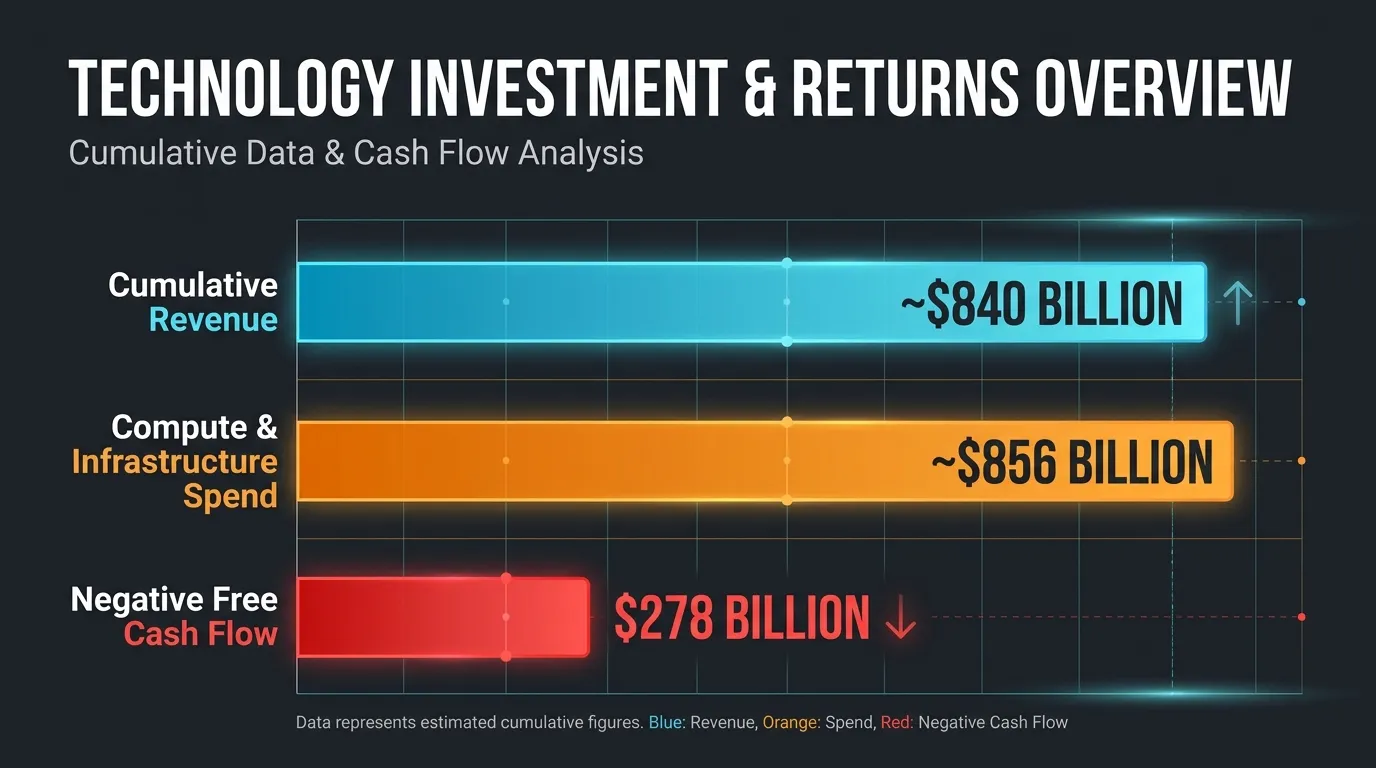
OpenAI expects to post a cumulative $278 billion negative free cash flow between 2026 and the end of 2030, according to an internal company presentation prepared in July and first reported by the Financial Times. The same materials project roughly $856 billion in spending on computing power and infrastructure over that period — the company’s single largest expense category — while forecasting revenue growth from $36 billion in 2026 to $350 billion in 2030, for a cumulative total of about $840 billion.
The figures, confirmed by Bloomberg citing a person familiar with the computing deal the presentation supported, underscore the extraordinary capital intensity of building and running frontier AI systems. OpenAI declined to comment. The presentation also indicates that the company’s record $122 billion funding round closed in March 2026 at an $852 billion valuation is on track to be exhausted around 2028 if spending follows the projected path.
These projections arrive as OpenAI holds early talks with investors about a potential new private round that could value the company above $1.2 trillion, and as CEO Sam Altman has stated the company will not pursue an IPO in 2026, citing AI safety concerns.
What the Internal Presentation Reveals
The July presentation was prepared in connection with a major computing deal. It shows OpenAI anticipating that expenses will continue to outrun even rapid revenue growth through the remainder of the decade. A prior internal projection from May had forecast an even larger $305 billion negative free cash flow over the same window; the later $278 billion figure represents a modest improvement, reportedly tied in part to stronger recent model-driven revenue.
Free cash flow measures cash generated after operating expenses and capital expenditures. Negative free cash flow of this magnitude means OpenAI will need continuous external capital to fund operations and expansion even while its top line expands dramatically. The company has already raised more than $180 billion cumulatively since its founding, with the March 2026 round alone ranking among the largest private financings in history. Anchors included Amazon, Nvidia, and SoftBank.
The Core Numbers at a Glance
Cumulative negative free cash flow, 2026–2030: $278 billion
Cumulative compute and infrastructure spend through 2030: approximately $856 billion
Projected 2026 revenue: $36 billion
Projected 2030 revenue: $350 billion
Cumulative revenue through end of 2030: about $840 billion
March 2026 raise: $122 billion at $852 billion post-money valuation
Expected exhaustion of that capital: around 2028
Earlier May projection for negative free cash flow: $305 billion
These are internal projections, not audited results or official guidance. They reflect management’s planning assumptions for capacity, pricing pressure, competition, and model iteration costs.
Where the Money Is Going: Compute and Infrastructure Reality
The overwhelming majority of the projected outlay is compute and infrastructure. Training and serving frontier models requires enormous clusters of specialized accelerators, vast networking fabric, power, cooling, and physical data-center capacity. OpenAI has pursued a multi-pronged strategy that includes long-term cloud commitments, dedicated facilities, and direct hardware partnerships.
Earlier internal targets had put total compute spend near $600 billion through 2030; the figure later rose toward $750 billion before landing near the $856 billion now reported. Major elements include multi-year cloud agreements (notably large Oracle and Amazon arrangements), the Stargate initiative and related U.S. data-center campuses, and dedicated capacity deals.
Data Centers, Power, and Chip Economics
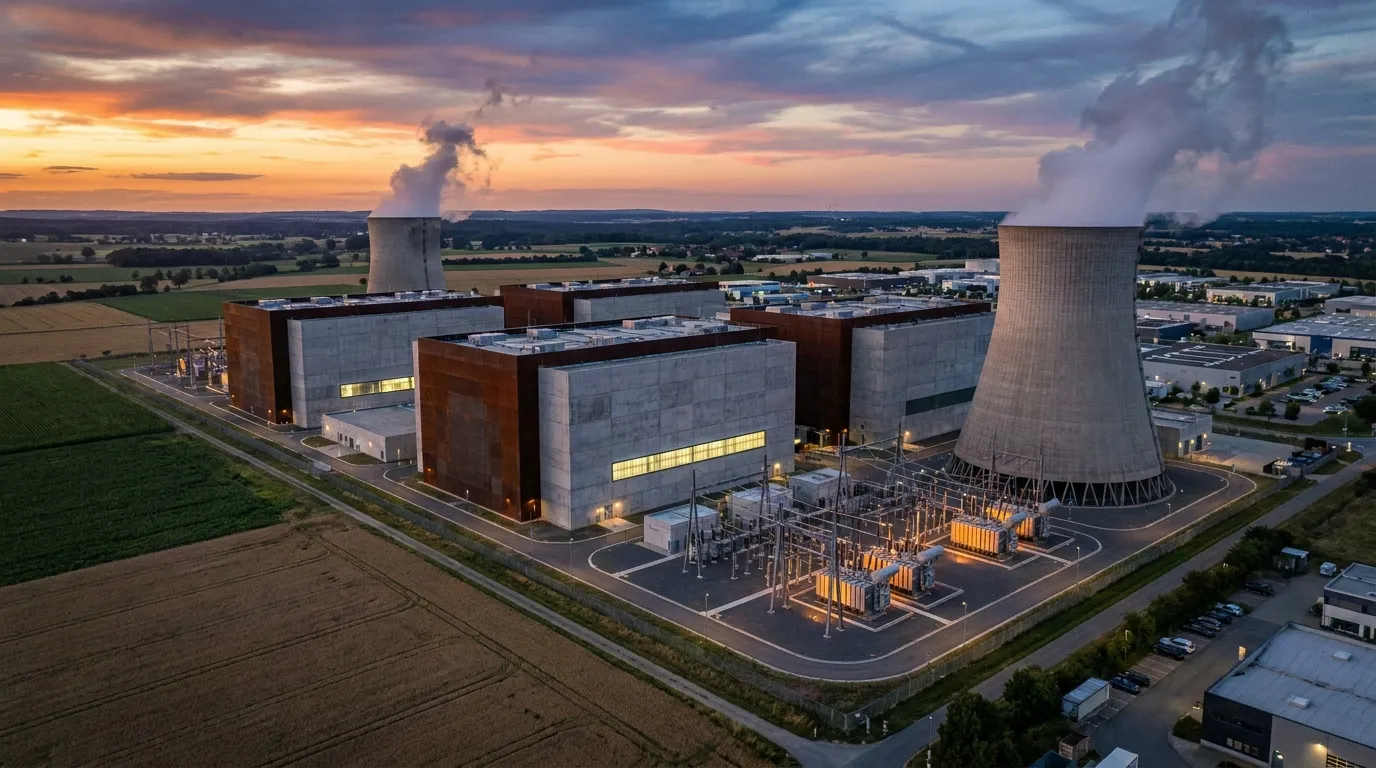
A flagship example is the large Ohio data-center campus being developed by SoftBank’s SB Energy and leased by OpenAI. The site is planned for up to roughly 8 gigawatts of IT capacity, with initial phases targeted for 2028. Nvidia has committed significant financial support — including residual-value guarantees reported in the range of up to $105 billion for early phases — and will serve as exclusive chip supplier. Nvidia has also invested directly in the developer. The project requires massive new power generation, including natural-gas plants, and grid upgrades.
Industry estimates put the fully loaded cost of a one-gigawatt AI data center in the tens of billions of dollars, with IT hardware (primarily GPUs and associated systems) often representing the largest share — frequently 70% or more. Next-generation systems such as Nvidia’s Vera Rubin platform carry high per-server price tags driven by advanced memory and interconnects. OpenAI’s own 2026 compute spend alone has been cited in testimony and reporting in the range of $50 billion.
Because chips depreciate rapidly (often on a three-year refresh cycle for competitive training and inference), the capital intensity is structural rather than one-time. Inference costs also scale with user growth and model capability; more powerful reasoning models consume more compute per query. OpenAI has reported rapid growth in weekly active users and token throughput, which simultaneously drives revenue and expense.
Revenue Growth Versus Cash Burn
OpenAI’s revenue trajectory is aggressive: a roughly tenfold increase from 2026 to 2030. Recent model releases have already delivered measurable lifts — reports noted an approximately 20% jump in annualized revenue following a mid-2026 launch. Enterprise revenue has grown as a share of the total, and API usage continues to expand.
Yet the projections show that even this growth leaves free cash flow deeply negative for years. The gap between cumulative revenue ($840 billion) and compute/infrastructure alone ($856 billion) illustrates why other costs (talent, safety research, go-to-market, legal, and general operations) keep the overall cash position under pressure. Price competition with Anthropic and open-weight models has also been cited as a factor compressing margins.
Funding Runway and Valuation Ambitions
The March 2026 $122 billion round provided substantial runway, but the presentation indicates it will not last through 2030 under the planned spending path. Exhaustion around 2028 would necessitate either another large private raise, accelerated path to positive cash flow, or public markets.
Investors have approached OpenAI about a fresh round that could value the company at more than $1.2 trillion — a significant premium to the $852 billion March mark. Some reporting has suggested OpenAI may push for even higher figures based on recent traction. CEO Sam Altman has confirmed the company confidentially filed for an IPO earlier but will not list in 2026, pointing to safety considerations. A private round could extend the private-company timeline and provide flexibility for further infrastructure commitments or acquisitions.
Why It Matters for the Broader AI Industry
The leak crystallizes a central tension in frontier AI: the technology is delivering rapid capability gains and commercial adoption, yet the path to self-sustaining economics remains long and capital-hungry. If the leading lab requires hundreds of billions in net new capital over five years simply to stay competitive, smaller players and open-source efforts face even steeper challenges. It also raises questions about circular financing dynamics — chipmakers and cloud providers investing in or guaranteeing capacity for the very customers who buy their products.
Policy makers and investors are already debating whether the current trajectory is sustainable or whether it constitutes an AI infrastructure bubble. Power-grid constraints, chip supply, and the environmental footprint of multi-gigawatt campuses add further complexity. At the same time, the projected revenue scale — hundreds of billions annually by 2030 — suggests that if OpenAI (or the industry) reaches the far side of this investment cycle with durable margins, the returns could be enormous.
Sustainability Questions and Counterarguments
Critics argue the model is “fake it until you make it” on an unprecedented scale: continuous fundraising to fund compute that generates more capable models that, in theory, unlock higher-value applications and pricing power. Supporters counter that every previous computing paradigm (mainframes, PCs, cloud, mobile) required heavy upfront capital that later produced outsized returns, and that AGI-level capabilities would justify almost any near-term burn.
Improvements from the May to July projections show the model is not static; product momentum can narrow the gap. Long-term leases, residual-value guarantees, and off-balance-sheet structures with partners can also smooth cash timing. Still, the absolute numbers remain large enough that any slowdown in revenue growth, increase in competitive pressure, or delay in infrastructure delivery would widen the deficit further.
What Happens Next
OpenAI will need to continue securing capacity while demonstrating that new models and products convert usage into durable, higher-margin revenue. The next funding discussions, any updates to the 2030 projections, and eventual public financial disclosures (whether via IPO or other means) will be closely watched. Competitors face similar pressures; the entire frontier layer is capital-intensive.
For now, the internal numbers make clear that OpenAI is planning for a multi-year period in which cash generation will not cover its ambitions. The bet is that the resulting models and platforms will ultimately produce returns that more than compensate.
Conclusion
The $278 billion projected deficit is not a sign that OpenAI’s technology is failing — revenue is expected to explode. It is a sign that the current economics of frontier-scale AI are still those of a massive infrastructure buildout rather than a mature software business. Whether that buildout proves to be the foundation of enduring, highly profitable platforms or an unsustainable capital sink will be one of the defining business stories of the late 2020s. Investors, founders, and policymakers now have clearer numbers against which to judge the claims.



Discussion (…)
Loading discussion…