
OpenAI released GPT-6 Sol and GPT-6 Luna on September 22, 2026, the same day Anthropic introduced Claude Opus 5.5. The same-day launches are confirmed. What needs more care is the comparison: these are different model tiers, and the companies did not make identical price cuts.
For developers, the useful question is not simply which model has the highest benchmark score or the cheapest output tokens. It is which configuration can complete an acceptable piece of work at the lowest total cost.
This analysis covers Sol and Luna—not the entire GPT-6 family—and uses documentation and published evaluations checked on September 24, 2026. xSypher has not conducted a controlled hands-on comparison. The cost examples below are calculations, not measured production results.
What launched—and how Sol and Luna differ
Sol and Luna expand an existing GPT-6 family that already includes Astra. OpenAI positions Sol for demanding coding and agentic workflows: tasks in which a model takes multiple steps and uses tools. Luna targets focused, high-volume work where efficiency matters more than maximum capability. They should not be treated as interchangeable versions of the same product.
OpenAI lists a 1.05-million-token context window and a 128,000-token maximum output for both models. Anthropic lists a one-million-token context window and the same maximum output for Opus 5.5. These are capacity limits, not evidence that the models reason equally well over everything placed in that context.
At launch, Sol and Luna became available in the API and in ChatGPT Work and Codex for Plus, Pro, Business, Enterprise and Edu users. Free and Go users received access to Luna in the desktop app. OpenAI explicitly distinguished this rollout from availability in ordinary Chat.
Opus 5.5 is available through the Claude API and supported cloud platforms, including Amazon Bedrock, Google Cloud and Microsoft Foundry. Developers using Anthropic’s API select it with the model identifier claude-opus-5-5. 4
API pricing: not two identical 50% cuts
OpenAI says Sol and Luna’s API prices are 50% below their corresponding GPT-5.6 promotional prices. That comparison matters: it is not a blanket statement about every previous OpenAI flagship or subscription plan.
Anthropic’s standard input and output rates fell 20% from Opus 5, from $5/$25 to $4/$20 per million tokens. Separately, Anthropic estimates a 40% reduction in typical workload costs at default settings. That is a company-reported workload estimate, not the list-price discount.
The published standard API rates are:
Model | Uncached input, per 1M tokens | Cached input reads, per 1M tokens | Output, per 1M tokens |
GPT-6 Sol | $2.00 | $0.20 | $10.00 |
GPT-6 Luna | $0.10 | $0.01 | $0.50 |
Claude Opus 5.5 | $4.00 | $0.20 | $20.00 |
These are API usage prices, not subscription charges. The OpenAI figures above use its short-context Standard rates; cache writes, tools and other processing options are separate considerations.
For a simple accounting example, consider 10 million uncached input tokens and two million billable output tokens, aggregated across requests below the long-context threshold. At those rates, the model charges would be:
GPT-6 Sol: $40
GPT-6 Luna: $2
Claude Opus 5.5: $80
This calculation excludes caching, tool charges, regional premiums and alternative processing tiers. It assumes identical billed token counts, rather than identical work performed.
That distinction is important. Tokens are the units models process and generate, and different tokenizers can assign different counts to the same text. Equal token budgets are therefore not automatically equal workloads.
Caching and long context change the calculation
Caching lets an application reuse previously processed prompt content. At the short-context rates above, Sol and Opus 5.5 charge the same $0.20 per million cached-read tokens. Their write charges differ: Sol lists $2.50 per million cache-write tokens, while Opus lists $5 for five-minute writes and $8 for one-hour writes. Retention and reuse patterns belong in the calculation, not just the headline read discount.
Long context changes the comparison again. For Sol requests exceeding 272,000 input tokens, OpenAI applies higher rates to the full request: uncached input becomes $4 per million and output becomes $15. Opus 5.5 retains standard pricing across its supported one-million-token context window. Sol’s short-context input-price advantage therefore disappears in that comparison.
A procurement spreadsheet built around a single input/output price pair can miss both effects.
What independent benchmarks actually show
Artificial Analysis compares GPT-6 Sol at maximum reasoning effort with Opus 5.5 using maximum adaptive reasoning and default fallback. Its published comparison, checked on September 24, showed:
Artificial Analysis metric | GPT-6 Sol, max | Opus 5.5, max with default fallback |
Intelligence Index | 48 | 58 |
Terminal-Bench 4.0 | 44% | 60% |
Estimated cost per Intelligence Index task | $1.06 | $5.98 |
In this configuration, Opus leads on the displayed capability measures while Sol costs less per evaluated task. These are the evaluator’s results, not xSypher measurements.
The Intelligence Index version shown is v4.3.2, combining ten evaluations. It is primarily a text-based, English-language suite, rather than a universal assessment of every language, modality or enterprise workflow.
The cost figure also needs its definition. Artificial Analysis calculates a weighted average across its benchmark tasks using token consumption and pricing. It is not a company’s cost per accepted support resolution, merged code change or approved document.
“Default fallback” is another material qualification. Anthropic supports retrying declined requests on a recommended alternative model. A result obtained with fallback should be understood as a configured system result, not necessarily the isolated model answering every task itself.
Anthropic’s own launch evaluation reports 66.4% on Terminal-Bench 4.0 using its stated setup. That number should not be substituted for Artificial Analysis’s result in a supposedly like-for-like table. Evaluator, effort level and execution environment belong beside the score.
API latency: output speed is not completion time
Anthropic says Opus 5.5 generates output more than 30% faster than Opus 5. This is a company-reported comparison with its predecessor—not proof that it finishes tasks faster than Sol or Luna.
The Artificial Analysis comparison reviewed for this article did not display corresponding Opus 5.5 latency and output-speed figures. It therefore does not establish a paired API-speed winner here.
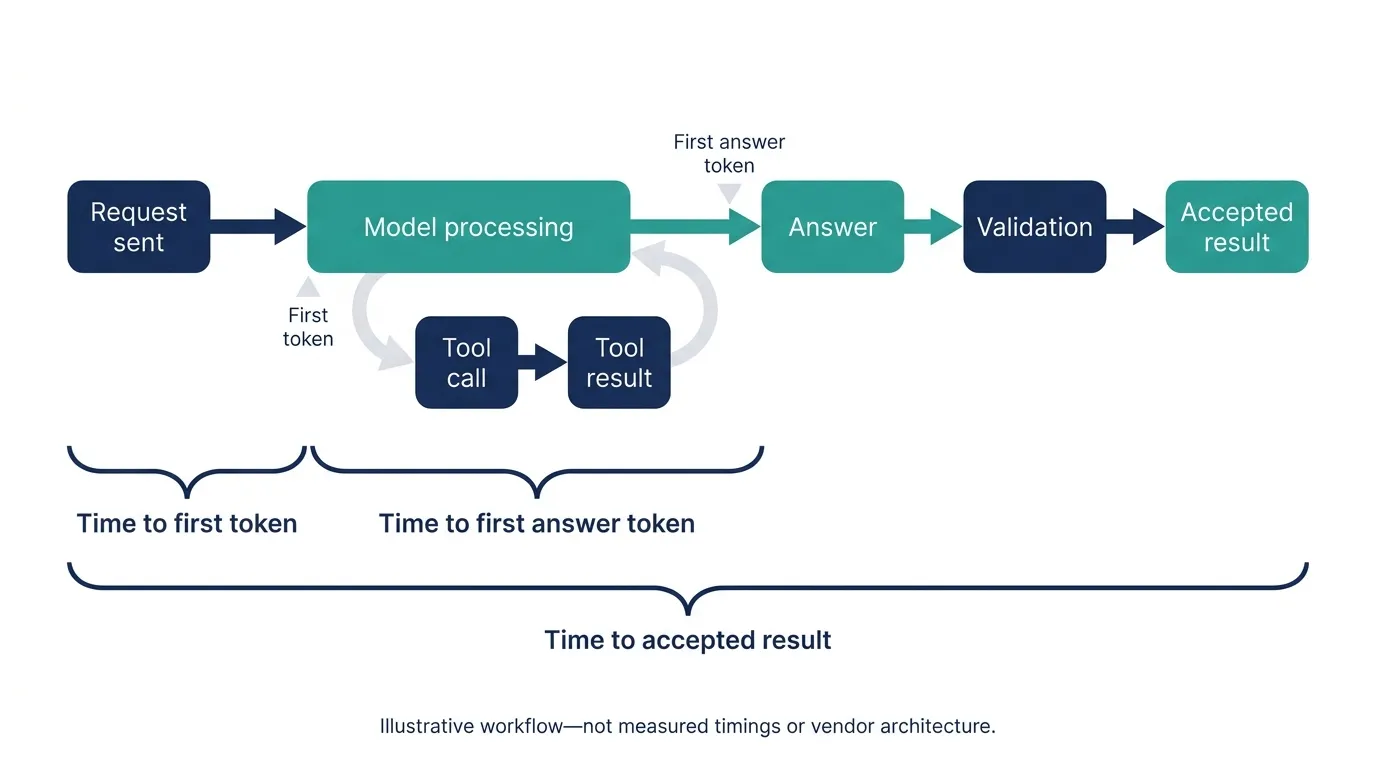
A useful latency comparison separates three measurements:
Time to first token: how long the endpoint takes to begin returning tokens; these may be reasoning tokens.
Time to first answer token: how long the user waits for the actual answer to begin.
End-to-end response time: the wait for the complete response, including processing, reasoning and generation.
For an agent, even the last measure is not the whole job. Tool calls, additional model requests and sequential dependencies can extend completion time. A model that emits text quickly may still take longer to finish an operation if its workflow requires more round trips. OpenAI’s latency guidance explicitly treats request count and parallelization as separate optimization factors.
Reasoning settings also differ. Sol and Luna support a non-reasoning setting; Opus 5.5 uses always-on adaptive thinking, with medium effort as its default. Comparing one model with reasoning disabled against another at maximum effort would answer a different question from comparing their default experiences.
For a deployment decision, test the intended endpoint, processing tier, prompt lengths, cache conditions and concurrency. Record both typical waiting time and slow-tail behavior—not just the best run.
Migration changes developers should not overlook
For Sol and Luna, OpenAI recommends the Responses API for reasoning with tools. Function calling through Chat Completions is supported only when reasoning effort is set to none. A model-name replacement alone is therefore not a sufficient migration check.
Opus 5.5 has its own compatibility changes. Requests that disable thinking or force particular tool-selection modes can return HTTP 400 errors. Text between tool calls also moves into thinking blocks whose text is omitted under the default display setting. An application expecting ordinary text progress updates can consequently appear silent between tool calls unless its integration is updated.
That last change is especially relevant to perceived latency: a quieter interface is not, by itself, evidence of slower model execution.
Processing requirements can constrain the available speed options, too. OpenAI’s documentation currently limits GPT-6 EU data residency to Standard processing. Teams requiring that configuration should not assume they can combine it with another processing tier’s performance characteristics.
Choosing a model for real work
The documentation suggests a sensible testing order, not an unconditional recommendation. Start by evaluating Luna on bounded, repetitive work; use Sol as a candidate for more demanding coding and agent workflows; and test Opus on long-running coding and knowledge tasks where an improvement in acceptance rate could justify additional spend. These starting points follow the vendors’ positioning, not an xSypher finding that any model will succeed on a particular application.
A practical validation plan
A useful internal comparison should make failure visible. OpenAI’s evaluation guidance recommends task-specific datasets, explicit success criteria, logging and human calibration rather than judging whether an output merely looks convincing.
For these models, a practical test plan would be:
Choose verifiable work. Use repository repairs with hidden regression tests, constraint problems with known valid solutions, and document extraction with checked reference answers.
Control the setup. Keep source material, tool permissions and acceptance criteria consistent. Compare defaults first, then configurations under matched spending or completion-time limits.
Repeat and record. Log failures, retries, fallback use, billed tokens, cache activity and review time. Preserve first-attempt results instead of reporting only a successful rerun.
Judge the completed outcome. For coding, require the relevant tests to pass. For business workflows, verify the resulting records or artifacts—not merely the model’s claim that it finished.
These are proposed validation steps, not tests xSypher has already run.
A useful operational measure is cost per accepted task: all API and tool charges across every attempt, plus review costs, divided by the number of accepted results. Set the acceptance criteria before comparing the bills.
That approach leaves room for different winners within the same organization. A low-cost model can be the right choice for a constrained extraction job, while a more expensive configuration may be justified if it materially reduces failed attempts or human rework. The decision should follow measured outcomes, not a single leaderboard position.
The September 22 launches create more options for that evaluation. They do not remove the need for it.




Discussion (…)
Loading discussion…